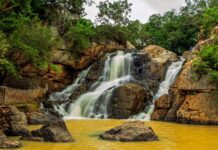
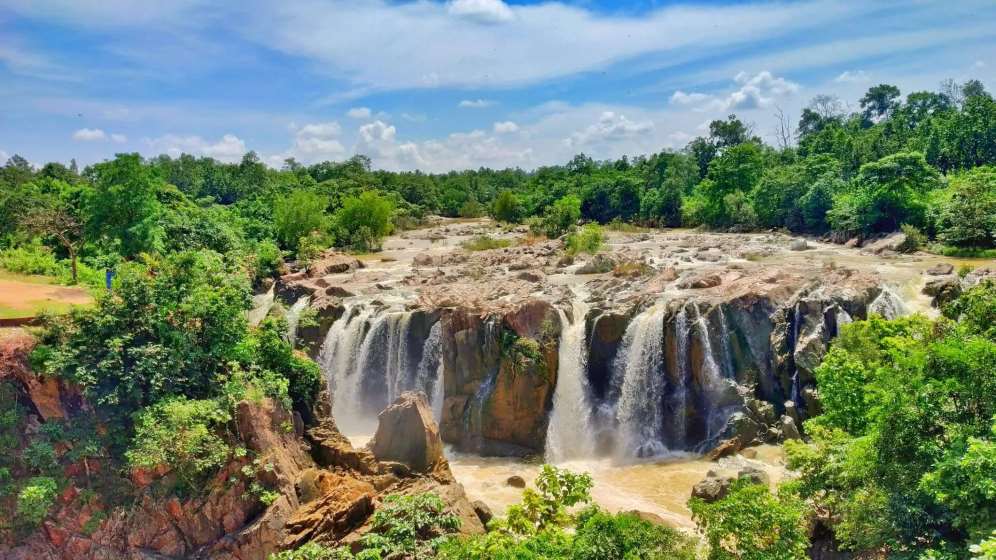
Keonjhar, officially Kendujhar, is one of Odisha’s most rewarding destinations for travellers who enjoy waterfalls, forests, hills and scenic road journeys. The district’s landscape includes forested uplands, rocky streams, river valleys, and several important natural attractions, making waterfalls a key part of a Keonjhar sightseeing itinerary.
Among the best-known waterfalls in Keonjhar are Sanaghagara and Badaghagara, two attractions that are easy to combine when staying around Keonjhar town. Further afield, travellers can explore Gundichaghai, Khandadhar, Handibhanga and Bhimkund, while places such as Gonasika, Kanjipani, Sitabinji and Ghatagaon can add cultural and scenic variety to a longer trip.
The important point is that these waterfalls are not all interchangeable. Some are convenient for a short outing from Keonjhar, while others make more sense as part of a wider road trip. Seasonal water levels, road conditions and local restrictions can also affect the experience.
This guide explains the best waterfalls in Keonjhar, when to visit, how to combine them, what to expect, monsoon safety precautions and how to fit waterfall sightseeing into a one-, two- or three-day Keonjhar itinerary.
Planning a complete trip to Keonjhar? Read our [Complete Keonjhar Travel Guide 2026] for information on the best places to visit, things to do, travel routes, accommodation and itinerary ideas.
Travel note: Conditions at waterfalls can change after heavy rain. Always follow local instructions and check the weather before travelling, particularly during the monsoon.
Why Is Keonjhar Famous for Waterfalls?
Keonjhar’s natural setting helps explain why waterfalls feature so prominently in its tourism landscape.
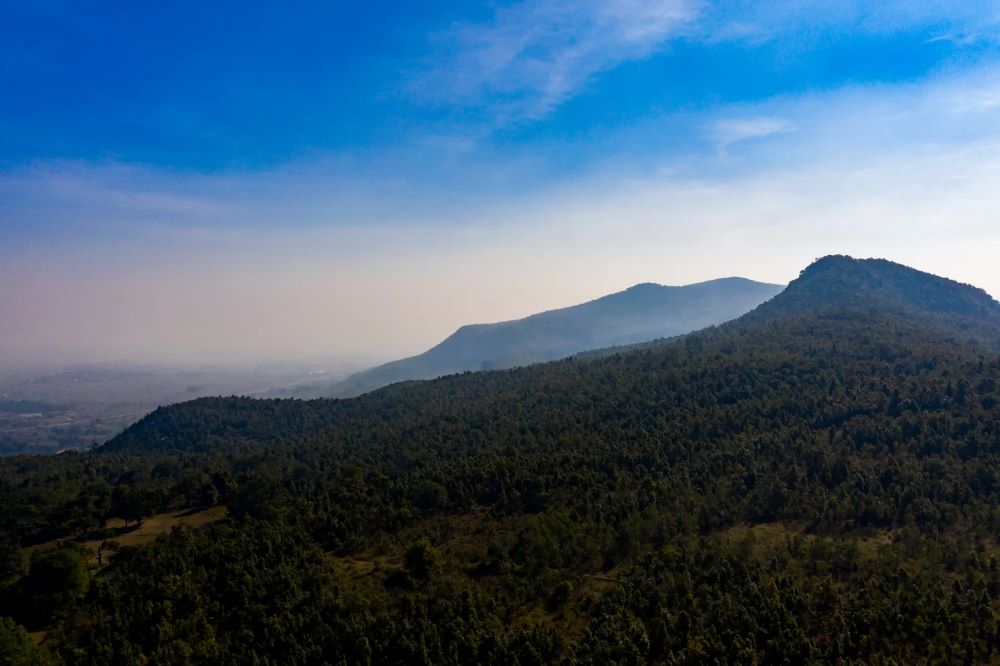
The district contains extensive forest areas, hills and streams, while seasonal rainfall increases the volume of many cascades during and after the monsoon. Rivers and smaller hill streams flowing across rocky terrain create natural drops, rapids and cascades.
Sanaghagara and Badaghagara are among Odisha’s major waterfalls and note that many of the state’s waterfalls occur where rivers originate or cross mountainous terrain.
Keonjhar’s attraction is therefore not simply the waterfalls themselves. The journey often passes through:
- Forested landscapes
- Hills and rocky terrain
- Small streams and rivers
- Rural settlements
- Scenic stretches of road
- Viewpoints and picnic areas
- Cultural and religious sites
This combination makes a waterfall trip in Keonjhar different from simply visiting one isolated viewpoint. You can also explore our Keonjhar Tour Package, which can be customised according to your travel dates and places you want to visit.
Best Waterfalls in Keonjhar
The following waterfalls and waterfall areas are among the most relevant for travellers planning a Keonjhar nature trip.
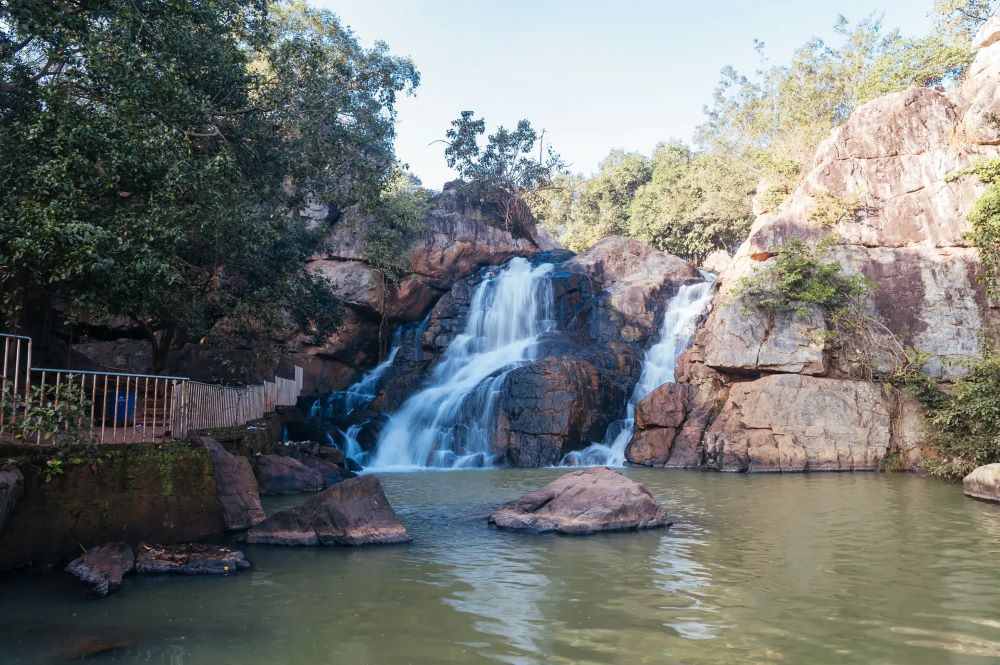
1. Sanaghagara Waterfall
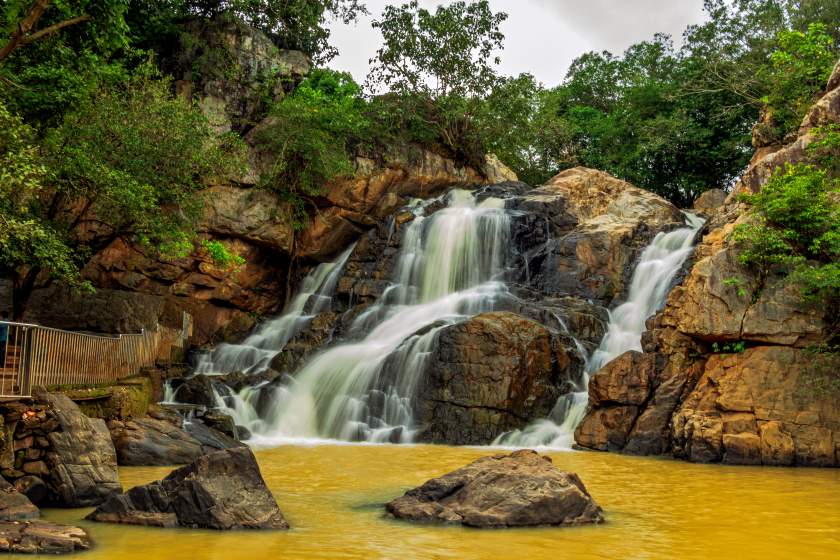
Sanaghagara Waterfall is one of the most accessible and well-known natural attractions around Keonjhar town. It is commonly paired with Badaghagara because the two are closely associated in Keonjhar’s tourism circuit.
The name itself reflects its relationship with Badaghagara: Odisha Tourism describes Sanaghagara as the smaller of the two waterfalls, while Badaghagara is the larger waterfall. The official tourism site also describes the two as twin waterfalls located close to one another.
Sanaghagara is associated with the Machha Kandana River and is surrounded by forested scenery. Odisha Tourism’s official road-tour material describes it as a perennial waterfall with two cascades and notes that the water collects in a turbulent pool that has been cordoned off for safety.
Sanaghagara roughly 8 km from Keonjhar town, although distances can vary depending on the reference point and route.
Why visit Sanaghagara?
- Convenient for travellers staying in Keonjhar
- Easy to combine with Badaghagara
- Forest and rocky scenery
- Suitable for a relatively short sightseeing stop
- Good opportunity for landscape photography
- Useful for families who want a nature outing without committing to a long-distance waterfall excursion
How much time should you allow?
For a sightseeing itinerary, allow roughly 1–2 hours, depending on how much time you spend walking around, taking photographs and enjoying the surroundings.
Best season
Sanaghagara can be visited beyond the monsoon, but the surrounding landscape becomes particularly attractive when the forest is green and the waterfall has good flow. After periods of heavy rain, however, water conditions can become hazardous.
Photography
The combination of falling water, rocks and greenery provides good opportunities for landscape photography. Avoid moving onto wet or unstable rocks simply to obtain a closer photograph.
2. Badaghagara Waterfall
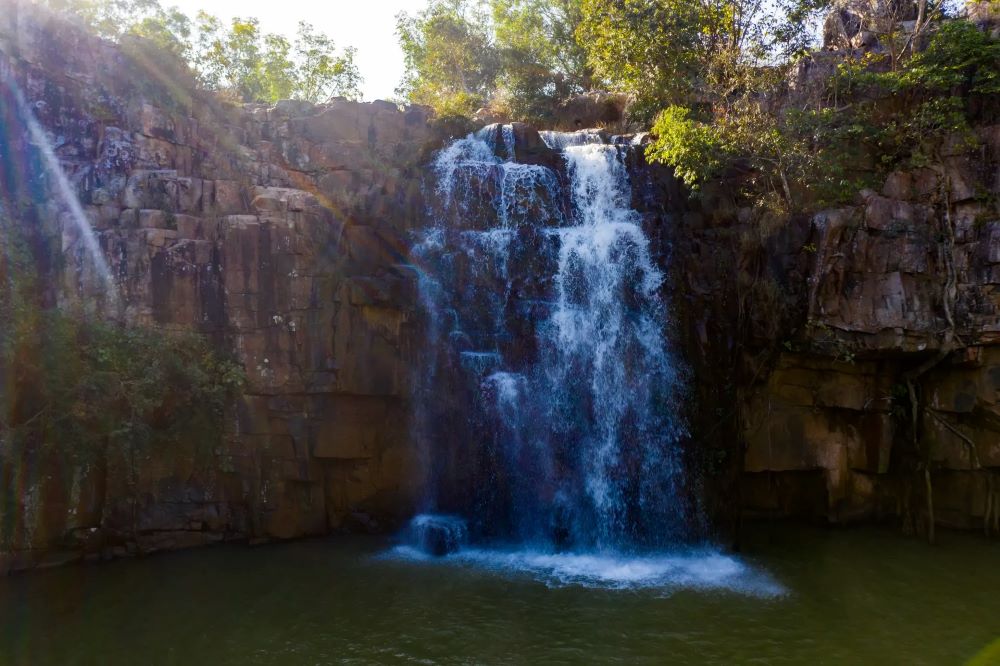
Badaghagara Waterfall is the larger companion to Sanaghagara and one of the signature natural attractions near Keonjhar town.
Badaghagara as a waterfall adjacent to Keonjhar town, surrounded by lush green forest. Its official tourism page gives a distance of about 10 km from Keonjhar town and describes the waterfall as approximately 100 feet high.
One of its distinguishing features is its setting. Rather than viewing it simply as a roadside attraction, visitors experience a waterfall surrounded by forest and hilly terrain.
Why visit Badaghagara?
- It is one of Keonjhar’s best-known waterfalls
- It is close enough to Keonjhar town for a half-day outing
- The forest setting adds to the experience
- It combines naturally with Sanaghagara
- The waterfall becomes particularly impressive when water flow increases
Sanaghagara and Badaghagara together
For first-time visitors to Keonjhar, visiting the two together is usually the most logical approach. Odisha Tourism itself includes Sanaghagara and Badaghagara together in its Keonjhar sightseeing programme.
Allow several hours for both rather than trying to rush through them.
3. Gundichaghai Waterfall
Gundichaghai Waterfall offers a different experience from the two waterfalls around Keonjhar town. It is located in a forested setting near Ghatagaon and is particularly interesting for travellers combining nature sightseeing with a visit to the Maa Tarini Temple at Ghatagaon.
Gundichaghai is about 12 km from Ghatagaon and around 50 km from Keonjhar town.
What makes Gundichaghai worth visiting?
- Forest surroundings
- A more secluded natural setting than the town-side waterfalls
- Attractive during the green season
- Good landscape photography
- Convenient to combine with Ghatagaon on a wider itinerary
Because it is considerably farther from Keonjhar town than Sanaghagara and Badaghagara, it is better treated as part of a broader sightseeing circuit rather than a quick stop between the two.
4. Khandadhar Waterfall
Khandadhar Waterfall in Keonjhar should not be confused with the similarly named Khandadhar waterfall in neighbouring Sundargarh district.
The waterfall is a major natural attraction, with water falling vertically from a height of around 500 feet amid mountainous surroundings. It is roughly 50–60 km from Keonjhar town.
The setting is considerably more dramatic than a short town outing. The waterfall is surrounded by hills and natural vegetation, and the vertical drop creates spray and a strong roaring sound.
Khandadhar therefore works best for travellers who have more time and want to include a major waterfall excursion in a wider Keonjhar road trip.
Important: Keonjhar’s Khandadhar should not be confused with the better-known Khandadhar waterfall in Sundargarh. When planning your route, verify that your destination is the Keonjhar district Khandadhar.
5. Bhimkund
Bhimkund is one of the more distinctive waterfall destinations associated with the Keonjhar region.
The waterfall is formed by the Baitarani River, and two waterfalls known as Sanakunda and Badakunda within the Bhimkund area. The site has a dramatic gorge-like setting, fast-moving water and dense greenery.
Bhimkund also has a strong religious and cultural association. Local tradition connects the site with the Pandavas during their exile, although this should be understood as a traditional belief rather than established historical fact.
Bhimkund is located toward the Keonjhar–Mayurbhanj side of the district rather than immediately around Keonjhar town.
Should you include Bhimkund in a short Keonjhar trip?
If you have only one day around Keonjhar town, Sanaghagara and Badaghagara are more practical.
Bhimkund makes more sense when:
- You have at least two or three days
- You are travelling by private vehicle
- You are planning a wider northern Odisha road trip
- You want to combine natural and cultural attractions
6. Handibhanga Waterfall
Handibhanga Waterfall is another significant waterfall surrounded by green forest and mountain ranges and stands about 200 feet. It is located roughly 45 km from Keonjhar town.
The surrounding area is relatively difficult to access, so travellers should not assume that every waterfall listed in Keonjhar is as straightforward to reach as Sanaghagara or Badaghagara.
For this reason, Handibhanga is better suited to travellers interested in a more exploratory waterfall outing rather than families looking for the simplest possible sightseeing stop.
Sanaghagara vs Badaghagara — Which One Should You Visit?
For most travellers, the answer is simple: visit both if your schedule permits.
| Factor | Sanaghagara | Badaghagara |
|---|---|---|
| Scenery | Forest, rocks and cascading water | Larger waterfall with forest surroundings |
| Accessibility | Convenient for a Keonjhar-town outing | Also convenient from Keonjhar |
| Family suitability | Generally better suited to a short family outing, subject to conditions | Suitable for families when local conditions permit |
| Time required | About 1–2 hours is reasonable | About 1–2 hours is reasonable |
| Photography | Cascades, rocks and greenery | Larger waterfall and forest landscape |
| Monsoon experience | Stronger flow and greener surroundings, but slippery conditions | Dramatic flow, with increased monsoon safety concerns |
| Overall experience | Easier, shorter nature stop | More dramatic waterfall experience |
These are not two competing attractions that require choosing one. They form the core twin-waterfall experience promoted in Keonjhar tourism material.
If you have only limited time, visit both rather than travelling much farther simply to add another waterfall.
Best Time to Visit Keonjhar Waterfalls
There is no single season that is perfect for every traveller. The ideal timing depends on whether you prioritise water flow, greenery, comfortable weather or easier sightseeing.
Monsoon
The monsoon can produce the most dramatic waterfall conditions. Streams receive more water and surrounding vegetation becomes intensely green.
However, this is also when caution is most important.
Heavy rainfall can lead to:
- Slippery rocks
- Strong currents
- Rapidly changing water levels
- Muddy or difficult approaches
- Temporary restrictions
Never assume that a waterfall is safe simply because other visitors are present.
Post-Monsoon
The period after the heaviest rains can be particularly attractive for sightseeing because greenery remains strong while conditions may be more manageable.
This is often a good compromise for travellers who want both scenery and comfortable exploration.
Winter
Winter generally provides pleasant conditions for road travel and outdoor sightseeing. It can be a good time to combine waterfalls with temples, heritage sites and scenic drives.
Sanaghagara, for example, is also a popular picnic destination during the cooler months.
Summer
Hot weather can make exposed sightseeing uncomfortable, particularly in the middle of the day. If travelling in summer, an early start is sensible.
Water flow may also vary considerably between different waterfall locations, so do not expect the same appearance as during or immediately after the monsoon.
Are Keonjhar Waterfalls Safe During the Monsoon?
They can be visited during the monsoon, but waterfalls should always be treated as potentially hazardous natural environments.
Follow these precautions:
- Do not enter strong currents.
- Do not swim where swimming is prohibited or unsafe.
- Avoid wet, sloping rocks.
- Stay away from cliff edges.
- Keep children within close reach.
- Do not stand in the stream simply for photographs.
- Watch for sudden increases in water level.
- Respect barriers and restricted areas.
- Follow instructions from local authorities or site staff.
- Check the weather before leaving.
- Avoid visiting during severe rainfall.
- Do not rely on photographs from previous visits to judge current conditions.
How to Visit the Waterfalls from Keonjhar Town
For travellers staying in Keonjhar, a private car or hired vehicle is generally the most convenient way to organise waterfall sightseeing, especially if the itinerary includes several attractions.
Private car
This gives you the greatest flexibility. You can spend longer at a waterfall you enjoy and adjust the itinerary according to weather and daylight.
Hired vehicle
A hired car is useful for visitors arriving by train or bus and wanting to explore attractions outside the town.
Local transport
Local buses and other forms of transport may serve parts of the district, but availability and convenience vary by destination. Do not assume that a remote waterfall has frequent public transport.
Why a vehicle helps?
A vehicle becomes particularly useful if your itinerary includes:
Keonjhar → Sanaghagara → Badaghagara → Gonasika / Sitabinji / Ghatagaon
or a longer circuit involving Khandadhar, Bhimkund or Gundichaghai.
Road and local access conditions can change, especially after heavy rain, so check locally before setting out.
One-Day Keonjhar Waterfall Tour Plan
If you have just one day, avoid trying to cover every waterfall in the district.
Suggested plan
Morning
Start from Keonjhar town and visit Sanaghagara Waterfall.
Allow around 1–2 hours for the waterfall and surrounding area.
Late morning/midday
Proceed to Badaghagara Waterfall.
Spend another 1–2 hours, depending on weather and how much time you want for photography.
Afternoon
Return toward Keonjhar and use the remaining time for one practical nearby attraction rather than adding a distant waterfall.
You could also keep the afternoon flexible for local sightseeing.
Why this works?
Sanaghagara and Badaghagara are the logical pair for a short waterfall-focused visit. Odisha Tourism itself uses both in the same Keonjhar itinerary.
Trying to add Khandadhar, Bhimkund and Gundichaghai to the same day would turn the trip into a rushed driving itinerary.
Planning to spend more than one day in Keonjhar? See our detailed Keonjhar Tour Plan for a suggested itinerary covering waterfalls, temples, nature attractions and other places to visit around Keonjhar.
Two-Day Keonjhar Waterfall Itinerary
Two days allow you to move beyond the immediate Keonjhar town attractions.
Day 1: Sanaghagara + Badaghagara + Keonjhar
- Sanaghagara Waterfall
- Badaghagara Waterfall
- Keonjhar town sightseeing
- Relaxed evening
Keep the first day relatively light.
Day 2: Choose a wider circuit
Depending on your starting and ending points, consider a combination involving:
- Khandadhar
- Gonasika
- Sitabinji
- Ghatagaon
- Maa Tarini Temple
Keonjhar itinerary combines Sanaghagara and Badaghagara with Sitabinji on one day, then Khandadhar, Gonasika and Ghatagaon on the following day.
Gonasika is associated with the origin of the Baitarani River and has the Brahmeswar Mahadev temple. The district administration places it around 30–40 km from Keonjhar, depending on the reference point used.
If your priority is waterfalls rather than religious sightseeing, replace some of the temple stops with a longer visit to Khandadhar or another practical waterfall destination.
For a complete list of attractions, travel tips and itinerary ideas, see our [Complete Keonjhar Travel Guide 2026].
Best Waterfalls in Keonjhar for Different Types of Travellers
Best for families
Sanaghagara and Badaghagara are the most practical choices for a family-oriented waterfall outing because of their proximity to Keonjhar town and their established place in the local tourism circuit.
Still, families should supervise children closely around water and rocks.
Best for photography
Khandadhar is particularly attractive for dramatic landscape photography because of its tall vertical drop and mountainous setting. Gundichaghai also offers forest, rock and mist-filled compositions.
Best for nature lovers
Gundichaghai is a strong choice if you want a forest-focused setting rather than only a quick waterfall stop.
Best for a short trip
Sanaghagara + Badaghagara.
They are the most sensible pair when your accommodation is in Keonjhar town.
Best for a road trip
A longer circuit involving Bhimkund, Keonjhar, Sitabinji, Kanjipani and Gundichaghai can be considered when you have several days.
Best for monsoon scenery
Sanaghagara, Badaghagara, Gundichaghai and Khandadhar can all be visually impressive when rainfall increases water flow and greenery, but the same weather also increases safety risks.
What to Carry When Visiting Keonjhar Waterfalls?
Pack according to the season and the type of waterfall you are visiting.
Basic checklist
- Drinking water
- Comfortable footwear with good grip
- Rain jacket or umbrella during the wet season
- Basic first-aid supplies
- Waterproof phone/camera protection
- Extra clothes if you expect to get wet
- Some cash
- Light snacks where appropriate
- A small waste bag
- Power bank for longer road trips
For remote attractions, do not depend entirely on finding shops or services immediately beside the waterfall.
Most importantly, carry your waste back with you if there is no suitable disposal facility.
Responsible Tourism Around Keonjhar Waterfalls
Waterfalls are part of a living natural landscape, not simply photography locations.
Responsible visitors should:
- Avoid littering.
- Minimise plastic waste.
- Carry back bottles and food packaging.
- Do not damage plants or rocks.
- Stay on established paths where available.
- Respect local communities.
- Follow signs and restrictions.
- Do not disturb wildlife.
- Avoid loud behaviour in forested areas.
- Never enter restricted zones for photographs.
- Do not leave religious offerings or other waste in natural areas.
This becomes particularly important at forest and rural waterfall sites where tourism infrastructure may be limited.
Waterfalls Near Keonjhar — What Can Be Combined?
A useful way to plan the district is to think in terms of clusters rather than trying to visit every waterfall from one base in one day.
Group 1 — Around Keonjhar
Sanaghagara + Badaghagara
This is the easiest waterfall combination for travellers staying in Keonjhar town.
Group 2 — Ghatagaon side
Gundichaghai + Ghatagaon Maa Tarini Temple
Gundichaghai is about 12 km from Ghatagaon according to the district administration, making the combination practical when you are already visiting the Ghatagaon area.
Group 3 — Longer nature and road circuit
Khandadhar + Gonasika + Sitabinji + Kanjipani
This is better suited to a multi-day itinerary because these attractions extend beyond the immediate town area.
Group 4 — Wider northern Odisha journey
Bhimkund + Keonjhar + surrounding attractions
Bhimkund can work particularly well when Keonjhar is part of a broader northern Odisha road trip rather than a one-day town excursion.
The important distinction is that not every waterfall listed in Keonjhar should be marketed as “near Keonjhar town.” Some are better described as district-level attractions.
How Many Days Do You Need to See Keonjhar Waterfalls?
1 day
Best for travellers who want the highlights.
Recommended focus:
Sanaghagara + Badaghagara
You can add limited town sightseeing if time permits.
2 days
Best for first-time visitors who want waterfalls plus a few major attractions.
Consider:
- Sanaghagara
- Badaghagara
- Khandadhar or Gonasika
- Sitabinji or Ghatagaon
3 days
Best for a more relaxed road trip.
You can consider a wider circuit involving:
- Sanaghagara
- Badaghagara
- Khandadhar
- Gonasika
- Sitabinji
- Ghatagaon
- Gundichaghai
- Kanjipani
- Bhimkund, depending on your route
The exact combination should depend on where you are staying and where you are travelling next.
For a first visit, it is usually better to enjoy fewer places properly than spend most of the trip inside a vehicle.
How to Reach Keonjhar
By road
Keonjhar is connected by road with major parts of Odisha. Road travel is particularly useful for waterfall sightseeing because many natural attractions lie outside the town.
A private car or hired vehicle is the most convenient option when your itinerary includes multiple waterfalls.
By train
Kendujhargarh railway station serves Keonjhar town. The district’s tourism information identifies it as the relevant railway station for attractions such as Badaghagara and Khandadhar.
For remote waterfalls, you will generally need onward road transport.
By air
For air travellers, Bhubaneswar is the main airport option referenced by the district administration for Keonjhar tourist attractions.
From Bhubaneswar, the practical approach is to continue by road, particularly if your trip includes several waterfall destinations.
Frequently Asked Questions
Which is the most famous waterfall in Keonjhar?
Sanaghagara and Badaghagara are among the most famous waterfalls in Keonjhar and are commonly visited together. These both are twin waterfalls close to one another and are important waterfalls.
Which are the best waterfalls in Keonjhar?
For a first visit, start with Sanaghagara and Badaghagara. If you have more time, add Gundichaghai, Khandadhar or Bhimkund depending on your route. Handibhanga is another significant option for travellers interested in less straightforward waterfall excursions.
Are Sanaghagara and Badaghagara the same waterfall?
No. They are two separate waterfalls associated with the same wider natural area. Sanaghagara is the smaller waterfall, while Badaghagara is the larger one, located close to one another.
What is the best time to visit Keonjhar waterfalls?
The monsoon and post-monsoon periods generally offer greener landscapes and stronger waterfall flow, but heavy rainfall can make waterfalls dangerous. Winter is more comfortable for general sightseeing. The best timing therefore depends on whether you prioritise water flow or easier travel conditions.
Can I visit Sanaghagara and Badaghagara in one day?
Yes. In fact, visiting them together is one of the most practical ways to experience Keonjhar’s waterfalls. They are close enough to be treated as one sightseeing circuit from Keonjhar town.
Are Keonjhar waterfalls safe during the monsoon?
They can be visited with appropriate caution, but heavy rain can produce slippery rocks, strong currents and sudden changes in water levels. Stay away from restricted areas and dangerous edges, never enter unsafe currents and follow local instructions.
Is Keonjhar good for a family waterfall trip?
Yes, particularly if the itinerary focuses on the more accessible attractions around Keonjhar town. Sanaghagara and Badaghagara are practical choices for families. Children should nevertheless be supervised closely around water, rocks and steep areas.
How can I reach Keonjhar waterfalls from Bhubaneswar?
The practical approach is to travel to Keonjhar by road and then use a private or hired vehicle for local sightseeing. Bhubaneswar is the nearest airport option for several Keonjhar attractions.
How many days are enough to explore Keonjhar waterfalls?
One day is enough for Sanaghagara and Badaghagara. Two days allow you to add attractions such as Khandadhar, Gonasika, Sitabinji or Ghatagaon. Three days are better for a broader waterfall and nature circuit.
Which waterfalls can be combined with a Keonjhar tour?
Sanaghagara and Badaghagara are the easiest combination. Gundichaghai works well with Ghatagaon. Khandadhar can be combined with Gonasika and other attractions in a longer itinerary. Bhimkund is better suited to a wider northern Odisha road trip.
Is Gundichaghai near Keonjhar?
Gundichaghai is within Keonjhar district but is not immediately beside Keonjhar town. It is about 12 km from Ghatagaon and around 50 km from the district headquarters.
Is there more than one Khandadhar waterfall in Odisha?
Yes. Travellers should be careful because Keonjhar and Sundargarh both have attractions called Khandadhar.